Japanese Kaomoji vs Western Emoticons: Why Kaomoji Smile With the Eyes, Emoticons With the Mouth
A Western emoticon like :) is read sideways and smiles with its mouth. A Japanese kaomoji like (^_^) sits upright and smiles with its eyes. That one difference shapes everything about how the two kinds of text faces look — and there's real research explaining why. (^_^)
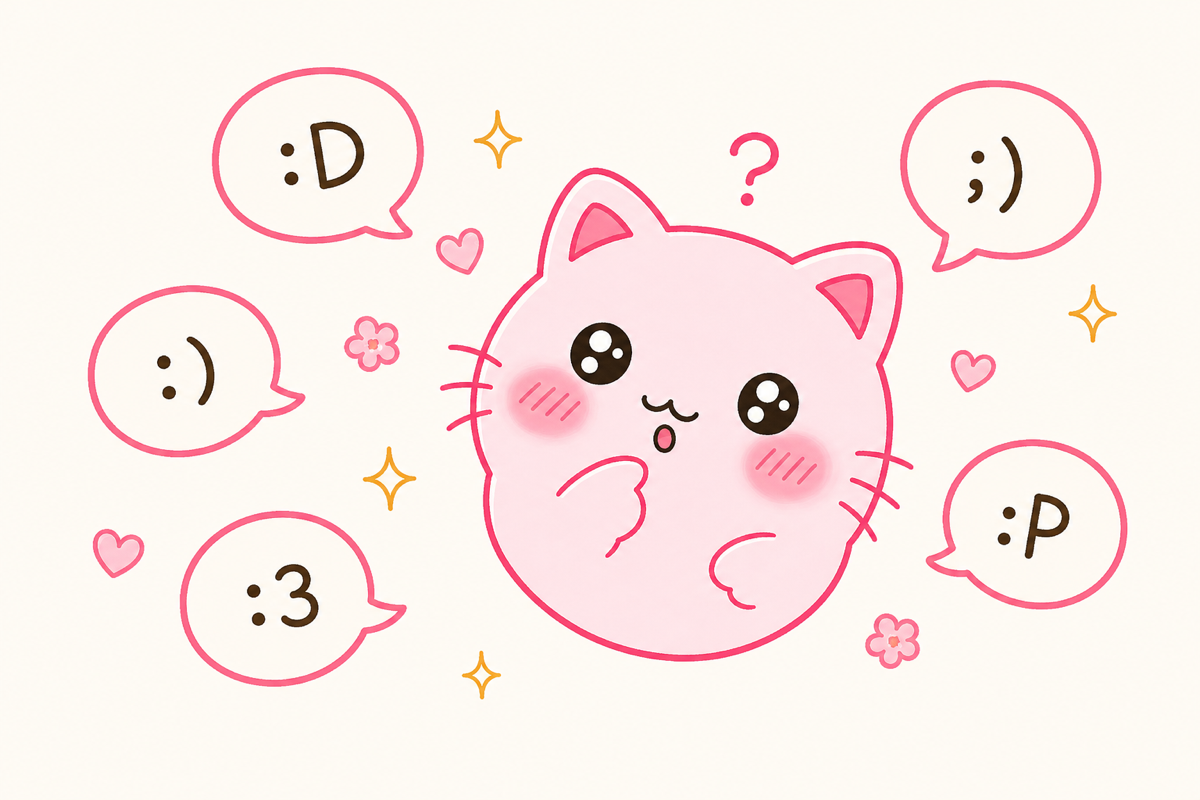
Short answer: Western emoticons (:), :D) are read sideways — tilt your head left and the : becomes the eyes, the next mark the mouth. Japanese kaomoji ((^_^), (T_T)) are read upright. The deepest difference: Western faces change the mouth to show emotion, while Japanese faces keep the mouth still and change the eyes.
If you've spent time online in English, you already read :) and :D without thinking. Japanese kaomoji feel like a different species — taller, upright, made of brackets and characters you might not recognize. They're not random. Once you see the one rule behind them, every Japanese face suddenly makes sense.
Kaomoji vs emoticon: what's the difference?
Both are emoticons in the broad sense — faces made of text, not picture characters like emoji 🙂. The split is between two traditions:
- Western emoticons are written sideways. :) :D ;) — short, typed in a second, read by tilting your head 90° to the left.
- Japanese kaomoji (顔文字, "face characters") are written upright and read straight on. (^_^) (>_<) (=^・ω・^=) — usually framed by parentheses, with the eyes doing most of the work.
So :) and (^_^) are the same idea — "I'm smiling" — expressed by two cultures in two opposite layouts.
How to read a Western emoticon: tilt your head
If Japanese kaomoji are new to you, the Western ones are worth a quick refresher, because the trick is the mirror image. The rule for Western emoticons is simple: tilt your head 90° to the left. The : becomes two eyes, and the mark beside it becomes the mouth.
A Japanese kaomoji needs no tilting — (^_^) already faces you. And notice where the emotion lives: in :D it's all in the mouth, while in (^_^) the smile is in the curved ^ ^ eyes.
Japanese vs Western, side by side
Line the two traditions up and the pattern jumps out: Japanese faces change the eyes; Western faces change the mouth.
| Feeling | Japanese (changes the eyes) | Western (changes the mouth) |
|---|---|---|
| Smile | (^_^) | :) |
| Big laugh | (^o^) | :D |
| Crying | (T_T) | :'( |
| Surprise | (゜o゜) | :O |
| Wink | (^_-) | ;) |
In the Japanese column, the mouth (_) barely moves — the eyes swing from ^ ^ (happy) to T T (crying). In the Western column it's the reverse: the eyes (:) stay fixed and the mouth flips from ) to (.
Why eyes vs mouth? The research
This isn't just a style quirk — it lines up with how people actually read faces. A 2007 study, "Are the windows to the soul the same in the East and West?" (Yuki, Maddux & Masuda, Journal of Experimental Social Psychology), found that Japanese viewers tend to read emotion from the eyes, while Western viewers weight the mouth more.
When the researchers showed faces with mismatched cues — happy eyes but a sad mouth, or the reverse — Japanese participants judged the feeling mostly by the eyes, and Americans mostly by the mouth. The two emoticon styles fall right out of that: a culture that reads the eyes builds faces that emote with the eyes (^_^ → T_T), and a culture that reads the mouth builds faces that emote with the mouth (:) → :(). The way each culture looks at faces is baked right into the punctuation.
The shop cat's note
Our mascot, Nyamoji, came to look at the Western emoticons too. She stopped in front of :3 for a while.
":3 … turn it sideways, and it's a little cat mouth. …Hey. Doesn't that look a bit like me?"
Tilt :3 and the 3 becomes a cat-like mouth — a "cute" face that's popular in the West too. Different countries, different layouts, and yet both traditions land on the same idea of cute.
In short
Western emoticons are read sideways and smile with the mouth; Japanese kaomoji stand upright and smile with the eyes. Once you know that one rule — and the eyes-vs-mouth research behind it — you can read either tradition on sight.
New to the upright kind? Start with what a kaomoji is, see how kaomoji differ from emoji, or just grab a cute one. (=^‿^=)
Grab a Japanese kaomoji, one tap to copy (=^‿^=)
A thousand-odd faces, sorted by mood.
FAQ
What's the difference between kaomoji and Western emoticons?
Western emoticons like :) are read sideways and show emotion through the mouth. Japanese kaomoji like (^_^) are read upright and show emotion through the eyes. Both are faces made of text, unlike emoji, which are picture characters.
Why do Japanese emoticons use the eyes?
Research (Yuki, Maddux & Masuda, 2007) found that Japanese people tend to read emotion from the eyes, while Westerners weight the mouth more. Japanese kaomoji reflect this: the eyes change from ^_^ (happy) to T_T (crying) while the mouth stays still.
How do you read :D?
Tilt your head 90° to the left. The : becomes two eyes and the D becomes a wide open mouth, so :D is a big grin or laugh.
What does (^_^) mean?
It's a Japanese kaomoji for a gentle smile. The ^ ^ are happy, curved eyes and the _ is a calm mouth. It reads upright, no tilting needed.
References
- Yuki, Maddux & Masuda (2007), "Are the windows to the soul the same in the East and West? Cultural differences in using the eyes and mouth as cues to recognize emotions," Journal of Experimental Social Psychology: sciencedirect.com/science/article/abs/pii/S0022103106000321
More from the blog: The kaomoji the world actually uses in 2026 · The kaomoji developers love.