The kaomoji the world actually uses in 2026 — and why they're not dead
Emoji, stickers and AI chat are everywhere now, so the little text faces should be long gone. They aren't. A 16-country survey says kaomoji are used worldwide every day, and there are good reasons they keep surviving the things that were supposed to replace them. (・ω・)ノ
Short answer: Yes, kaomoji are still very much used in 2026. A Simeji survey of 17,982 people across 16 countries found that one text face,  (an awkward, self-deprecating look), ranked #1 in 13 of those 16 countries. Kaomoji didn't lose to emoji; they kept the one job emoji can't do: being plain text that never breaks, in a terminal, a commit message, a tweet, or a chat box.
If you grew up online, you've probably assumed kaomoji were a phase. Phones ship thousands of emoji, every chat app has stickers, and now an AI will happily write your message for you. So a "face made of punctuation" feels like it should belong to an older internet. The interesting part is that the data points the other way, and the reasons are worth understanding if you write online at all.
What the world actually uses (the 2026 data)
The most useful recent number comes from Simeji's 2025 kaomoji ranking survey (Baidu Japan). It's an in-app questionnaire of 17,982 people across 16 countries, run in September 2025. It leans toward Simeji's keyboard users, but it's one of the few cross-country looks at how real people pick faces.
The headline finding: the single most-used kaomoji in the world was this.
An "awkward face" that carries confusion, embarrassment, and a little self-deprecation. It came in #1 in 13 of the 16 countries surveyed, which is about as close to a global default as a text face gets.
That face is built from rare combining characters, so on many screens it shows up as a blank box □ instead. Chrome, in particular, falls back to "tofu." That fragility, mojibake (text that garbles depending on the reader's environment), is exactly the trade-off that shapes which kaomoji travel and which don't. It's also why the simple faces below tend to win.
It isn't one flat global taste, either. The same survey found clear regional flavor:
- The mischievous Lenny face ( ͡° ͜ʖ ͡°) was popular in 8-plus countries.
- Russia and Argentina leaned toward heart faces.
- Vietnam favored cheering, "FIGHT☆"-style support faces.
- Indonesia and Thailand skewed toward joke / meme faces.
- India trended toward longer, decorated character strings.
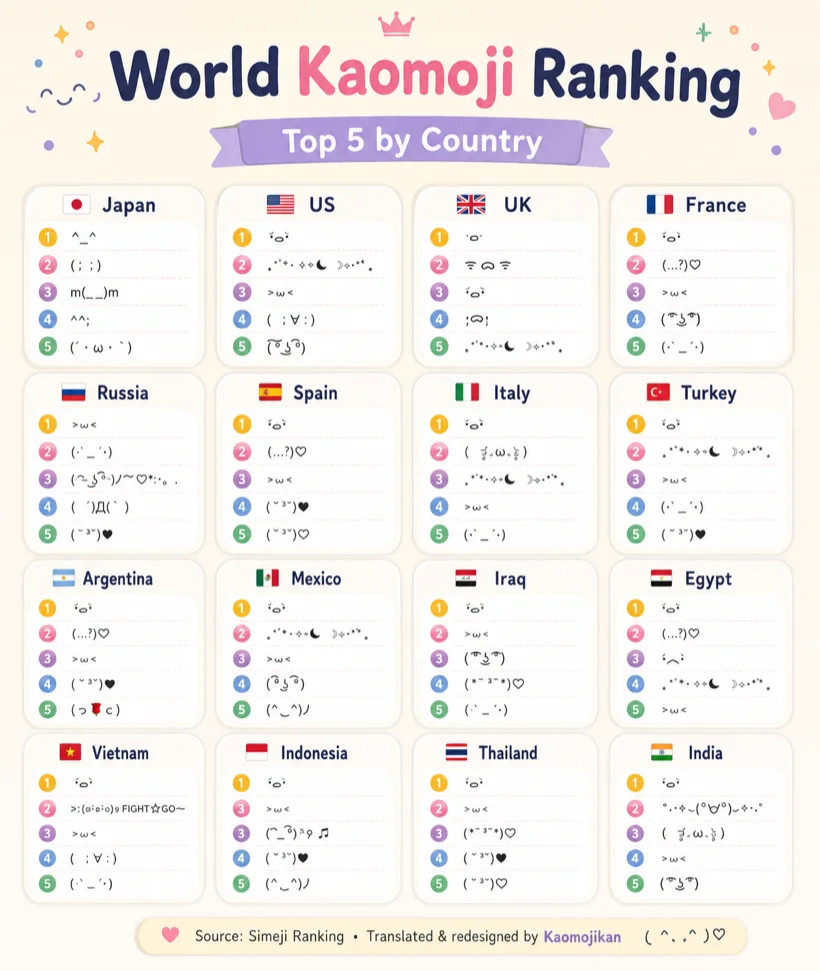
Simeji even declared October 10 a "Kaomoji Communication Day." You don't make a holiday for something that's dying. In Japan specifically, the top faces were the classics: ^_^ (smile), (;;) (crying), and m(_ _)m (a bow, for thanks or apology).
The same face means different things by age
The most telling part of the survey isn't which faces win. It's that the same face changes meaning across generations. That's the opposite of a dead format. A dead symbol has one fixed reading; a living one keeps getting re-interpreted.
| Age group | How they use kaomoji |
|---|---|
| 15–28 | As jokes, self-deprecation, and personal style. They'll use ^_^ ironically, as a deliberate "well, I messed that up" signal rather than a sincere smile. |
| 29–45 | For fine emotional nuance: softening a message, filling in the feeling that words alone can't carry. |
| 46–60 | For politeness: a sincere m(_ _)m to add courtesy to a thank-you or apology. |
So the cheerful ^_^ an older colleague types to mean "great, thanks" is the very same face a 20-year-old types to mean "ugh, I blew it." The characters haven't moved; the meaning has. Younger users aren't abandoning kaomoji; they're actively giving them new readings. That's a language being updated, not retired.
Why they're not dead, reason 1: plain text reads cold
Stripped of face, voice, and tone, a short message lands colder than you intend. "ok." can read as curt or even angry when it's just four neutral characters on a screen. People, younger users most acutely, feel that temperature gap and actively add emotion back in. A trailing face is the cheapest way to do it: "ok (•‿•)" is the same word made warm.
There's a deeper, cross-cultural reason kaomoji are good at this. In a 2007 study, Yuki, Maddux and Masuda found that Japanese readers tend to read emotion from the eyes, while Western readers weight the mouth more. It maps neatly onto the two emoticon traditions: the Western :-) is a sideways, mouth-first mark, while the upright Japanese kaomoji (^_^) puts the expressive work in the eyes. Faces that carry emotion through the eyes are very good at adjusting the warmth of a sentence, which is exactly the job people are hiring them for. (For the longer story of where these faces come from, see a short history of kaomoji.)
Why they're not dead, reason 2: they own a niche nothing else can
Emoji didn't replace kaomoji because emoji can't go everywhere kaomoji go. Kaomoji are made of ordinary characters, so they pass anywhere text passes, and stay intact where richer formats break or aren't allowed.
- They never break. An X post, a terminal, source code, a
git log, a monospace diff, a commit message: anywhere a string is valid, a kaomoji works. Emoji and stickers either can't be entered there or render as garbage. ¯\_(ツ)_/¯ survives a commit; an emoji often doesn't. - They express individuality. In the "kazari" (decoration) culture Simeji is known for, the same feeling has thousands of possible faces. You pick the one that's you, nudge it, decorate it. That endless combinability is room for personal style that a fixed emoji set simply doesn't have.
- They coexist with emoji; they weren't replaced. Plenty of people write (◍•ᗜ•◍)🌸, kaomoji and emoji side by side, choosing each for the moment. It's not a turf war; it's a toolkit. (If you want the precise differences, see kaomoji vs emoji.)
New for the AI era: text faces are also trivially generated, searched, and embedded by tools, because they're just strings: no image pipeline, no licensing, no Unicode-version roulette. A format that's pure text is, if anything, more convenient now, not less.
So, are kaomoji dead?
No. They changed roles and survived. They add the warmth plain text lacks, reach the places emoji can't, and leave room for individual style. Nuance, text-compatibility, and personality are the three things the data keeps pointing back to. That's why, in 2026, a 16-country survey still finds the same little awkward face winning almost everywhere, and why developers still flip tables in commit messages. It isn't a relic. It's a tool that quietly kept its job while flashier ones came and went.
New here? Start with what a kaomoji is, or just go grab one.
Find a face for the feeling (•‿•)
Browse a thousand-odd kaomoji by mood, one tap to copy.
FAQ
Are kaomoji dead in 2026?
No. A 2026 Simeji survey (16 countries, 17,982 people) found kaomoji are used worldwide every day, with an awkward face ranking #1 in 13 of 16 countries. They have changed how they are used, not disappeared.
Do young people still use kaomoji?
Yes. While older users send them for thanks and greetings, younger users (15–28) use the same faces ironically, for jokes, self-deprecation, and personality.
Why do kaomoji survive when emoji and stickers exist?
Because kaomoji are plain text, they work where emoji cannot (tweets, terminals, code, commit messages) without breaking, and they carry nuance and personality. They coexist with emoji rather than being replaced.
Aren't kaomoji an outdated thing only older people use?
It's closer to the opposite. The new faces topping 2026's rankings, like the world's #1 awkward face, are spread mainly by younger users, and the kaomoji keyboard Simeji skews young. If anything, today's kaomoji culture is led by the young, not left behind by them.
References
- Simeji (Baidu Japan), "World Kaomoji Ranking 2025" survey. In-app questionnaire, 17,982 respondents across 16 countries, September 2025: prtimes.jp/main/html/rd/p/000000925.000006410.html
- Yuki, Maddux & Masuda (2007), "Are the windows to the soul the same in the East and West? Cultural differences in using the eyes and mouth as cues to recognize emotions": sciencedirect.com/science/article/abs/pii/S0022103106000321
More from the blog: The funny story behind the kaomoji developers love · A mascot that follows your cursor.